


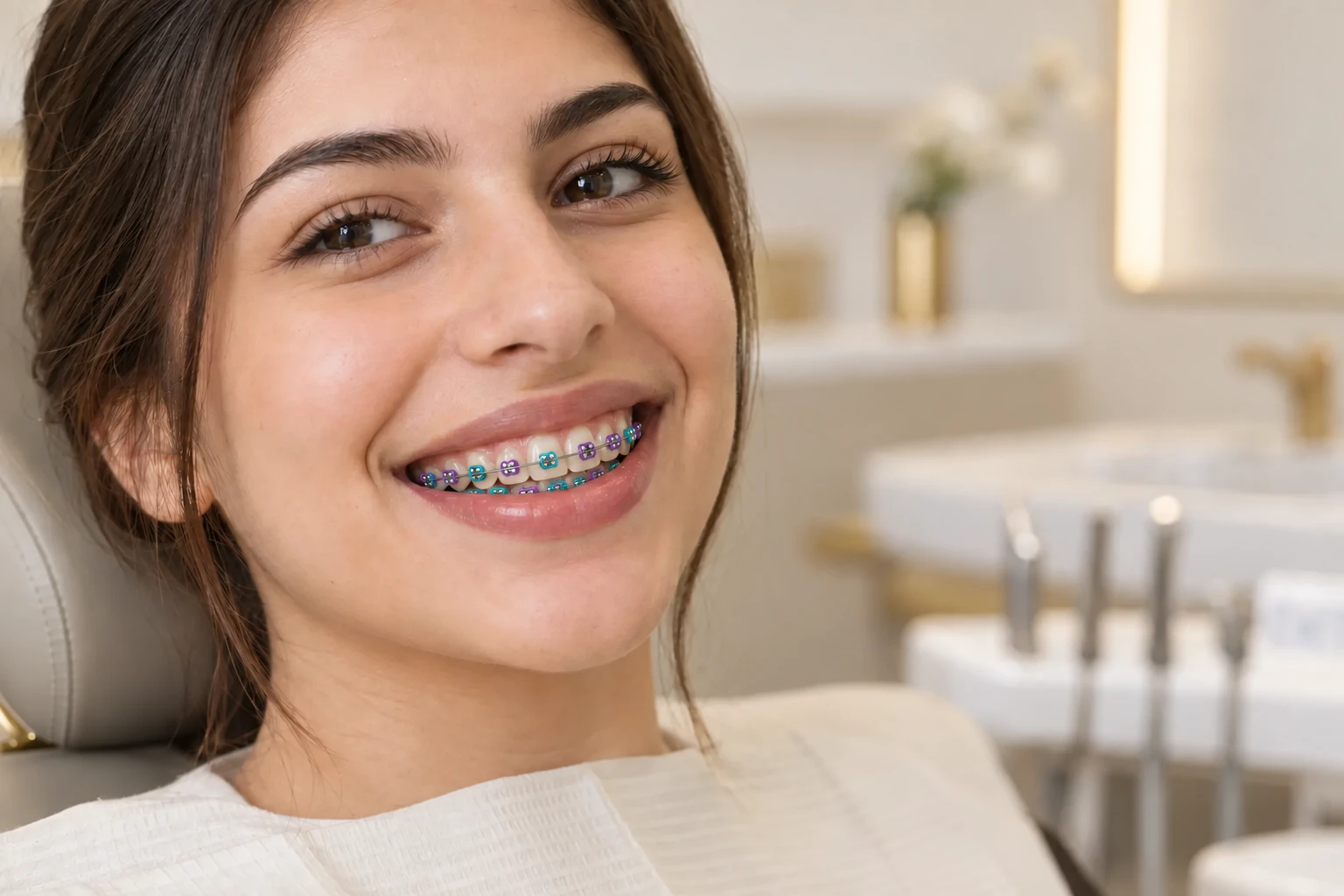
How much does orthodontic treatment cost worldwide?
Fees vary widely between countries, cities, and practices. Commonly published examples place private orthodontic treatment in the United Kingdom at roughly £2,000–£6,000, while comprehensive metal braces in Australia are often around A$7,000–A$9,000. Some aesthetic or digitally manufactured options can cost more depending on the case.
These figures are illustrations, not fixed quotations. Converting currencies does not create a fair comparison with treatment in Jeddah because local costs, follow-up systems, and what a package includes are different.
- Country, city, and operating costs.
- Clinician experience and specialist supervision.
- Case complexity and treatment duration.
- Appliance type and any required auxiliaries.
Which appliance types affect the fee?
The appliance should be chosen for the diagnosis, not appearance or price alone. Fees may differ between metal braces, ceramic or tooth-coloured fixed braces, Damon or fast braces, and removable clear aligners.
Damon or fast braces use self-ligating brackets. They may cost more than conventional metal braces, but the bracket name alone does not guarantee faster treatment. Duration depends on the problem, required movements, biological response, and cooperation.
- Metal braces: a practical fixed option for a wide range of cases.
- Ceramic or tooth-coloured fixed braces: less visible and may cost more.
- Damon or fast braces: self-ligating brackets selected when suitable for the plan.
- Clear removable aligners: require digital planning and consistent wear.
Why can specialist-led treatment cost more?
An orthodontic specialist's training focuses on tooth movement, jaw relationships, bite correction, and long-term planning. The value of care may include assessing roots and imaging, selecting controlled forces, monitoring gum health, finishing the bite, and planning retention after appliance removal.
A higher price alone does not guarantee a better outcome, and a lower price does not automatically mean poor care. A fair comparison looks at diagnosis, clinician experience, inclusions, follow-up, retainers, and how changes during treatment are managed.
Does a limited offer mean lower-quality care?
Not necessarily. A practice may offer a time-limited promotion, a reduced starting payment, or instalments to make treatment easier to begin. A clear offer should state what the initial payment includes, the cost of later visits, and whether imaging, retainers, or additional procedures are included.
A promotion does not replace diagnosis. Its purpose should be to improve access to an appropriate plan, not to place an appliance that does not suit the case.
What can raise or lower the cost of a case?
Two smiles can look similar while imaging, bite, and jaw relationships reveal very different levels of difficulty. Some cases need limited alignment; others require bite correction, space creation, auxiliaries, or longer supervision.
- Severity of crowding, spacing, or bite problems.
- One-arch or two-arch treatment according to the plan.
- Expected duration and number of reviews.
- Possible extraction, expansion, orthodontic mini-screws, or surgical coordination.
- Dental and gum health and any care needed first.
- Retainers and post-treatment review.
How should you compare braces offers in Jeddah?
Do not ask only, ‘How much?’ Also ask who will diagnose and supervise the case, what the treatment goals are, why a particular appliance is recommended, and what the fee includes through completion.
A useful estimate begins with a clinical examination and appropriate records. A preliminary range may sometimes be discussed from photographs, but the final plan and fee should not be confirmed before the teeth, gums, bite, and roots are assessed.
- Ask for the treatment plan and reasonable alternatives.
- Confirm the payment schedule, review visits, and inclusions.
- Ask about retainers and follow-up after braces.
- Do not use price as the only criterion for choosing care.
What patients often ask
Can braces cost be estimated from a photograph?
A preliminary range may sometimes be discussed, but an accurate fee requires examination because a photograph does not show roots, jaw relationships, or gum health.
Is the most expensive option always the best?
No. Many factors influence price. The suitability of the diagnosis and plan, clinician experience, and follow-up quality matter more than the number alone.
Does a low-priced offer mean poor treatment?
Not necessarily. It may be a limited promotion or payment arrangement, but you should understand what is included, who supervises care, and what later charges may apply.
Do Damon or fast braces always finish treatment faster?
No. They use self-ligating brackets and may suit selected plans, but duration depends mainly on movement complexity, biological response, cooperation, and treatment goals.
Are clear aligners always more expensive?
Digital planning, manufacturing, and the number of aligners can affect cost, but the difference varies with case complexity and the selected plan.