


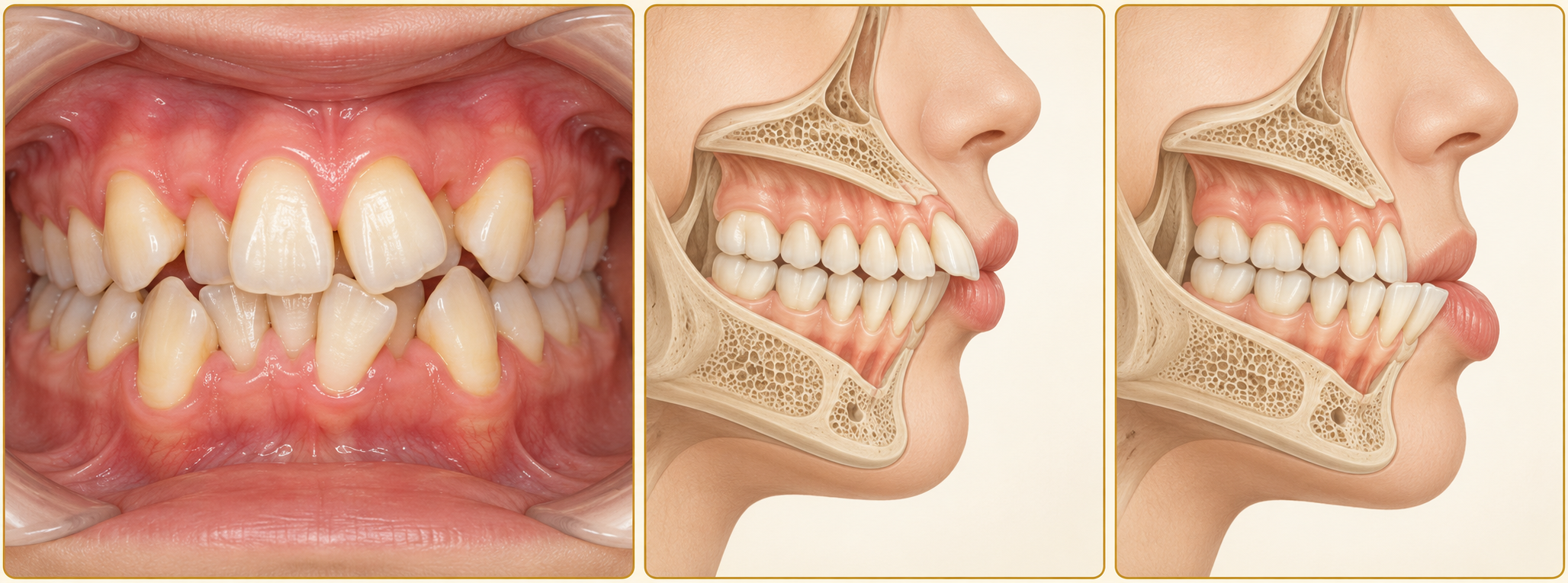
Severe crowding: when the arch lacks space
Crowding occurs when the space available in an arch is smaller than the space needed to align the teeth. A small jaw, larger teeth, or both may contribute. A discrepancy greater than 8 mm may be described as severe in some analyses, but the number alone does not determine extraction. The orthodontist also considers each arch, tooth positions, bone and gum limits, the bite and facial profile.
Space can also be lost during mixed dentition. Early loss of a baby molar, especially without a space maintainer when one is indicated, may allow the first permanent molar (the six-year molar) to drift forward and use space needed by permanent teeth that have not erupted. A retained baby tooth may obstruct or alter eruption; the effects depend on which tooth is involved and when it is lost or retained.
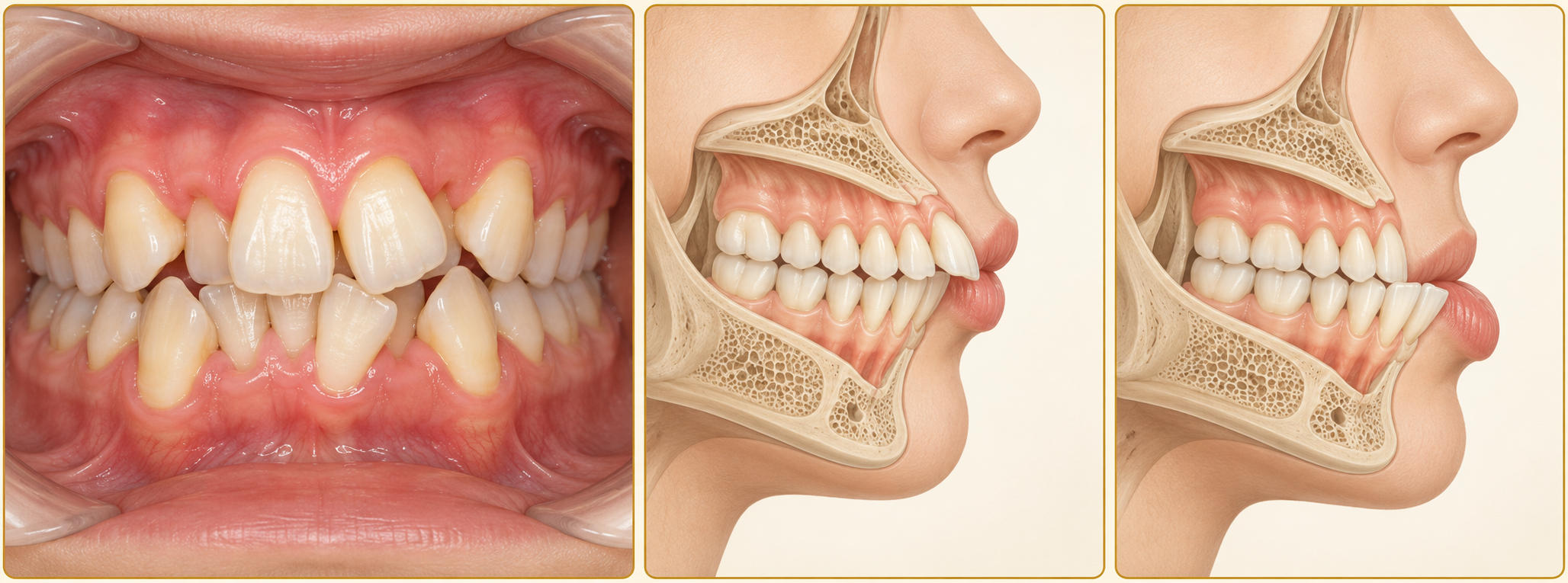
Protruding upper or lower front teeth
The front teeth may lean forward and affect lip closure or facial balance. When the prominence is mainly dental and the case is suitable, extraction can create room to retract teeth and improve the bite and profile.
Dental protrusion is different from prominent jaw bones. Extraction does not reposition the jaw bones, though it may support orthodontic camouflage in selected cases. A severe skeletal discrepancy may require joint assessment and discussion of jaw surgery.
Can extraction help avoid jaw surgery?
Sometimes. When the prominence is mainly dental, or a skeletal discrepancy is limited and safe tooth movement is possible within the bone and gum limits, an extraction-based orthodontic plan may improve tooth position and avoid surgery in selected cases.
This cannot be generalized to every patient. If the underlying problem is in the jaw bones or the discrepancy is severe, braces alone may not achieve the desired facial or functional change. Examination, records and analysis guide the choice.
What if needed space is not created?
If a plan requires space and it is not provided, crowding may remain or the front teeth may tip and protrude beyond a suitable position, affecting the bite, profile or gums. In some cases, bite problems, including an open bite, may worsen depending on the occlusion and movements used; this is not an inevitable result of avoiding extraction.
Conversely, extraction without a clear indication or sound space-closure planning can lead to unwanted retraction or spaces that are difficult to manage. The extraction decision is an important test of diagnostic and planning quality, not a stand-alone judgment of a clinician or a universal rule.
Does every orthodontic patient need extraction?
No. Many cases are treated without extraction, while others need one or more teeth removed to create space, reduce dental protrusion or coordinate the bite. The decision should not be based on a frontal photo alone; it follows assessment of the teeth, gums, bite and appropriate diagnostic records.
What patients often ask
Does 8 mm mean extraction is necessary?
No. It may indicate severe crowding, but it does not decide the plan by itself. The arches, teeth, face and bite are assessed together.
Can extraction correct prominent jaw bones?
Extraction moves teeth within the jaws; it does not reposition jaw bones. It may camouflage selected cases, while a severe skeletal discrepancy needs specialist assessment.
Will avoiding extraction cause an open bite?
Not necessarily. The bite may be affected if needed space is unavailable or movements do not fit the case, but open bite has multiple causes.
Does everyone with braces need extraction?
No. The decision depends on diagnosis, space, bite and facial profile; treatment may be planned with or without extraction.